FPGA CAD · Rust
Helion
An open-source FPGA toolchain I’m writing from scratch in Rust.
8.9×
faster than Yosys at synthesizing a PicoRV32 processor
My role
When
What it is
Helion takes hardware code written in SystemVerilog, VHDL, or C and turns it into a bitstream you can flash onto an FPGA. Think of it as my own open-source take on Vivado, written in Rust, with no vendor tools anywhere in the flow.
Why I built it
Vivado and Quartus, the tools everyone uses, don’t run on a Mac at all, and I couldn’t find a complete FPGA suite that runs natively on Apple Silicon. So I’m building one. I also wanted a tool that gives the same output every time, tells you exactly why something failed, and lets you verify what it did.
How I built it
I wrote every stage myself: synthesis, packing, placement, routing, timing analysis, and bitstream generation. On top of that there’s a simulator, a JTAG engine for talking to real boards, and a full IDE. CI checks on every push that the output is still identical run to run.
From code to bitstream.
Step 1 of 6
Synthesis
Turns your SystemVerilog or VHDL into a netlist of small logic cells.
- Synthesis: Turns your SystemVerilog or VHDL into a netlist of small logic cells.
- Packing: Groups those cells into logic blocks, eight to a block.
- Placement: Picks a physical spot on the chip for every block.
- Routing: Wires the blocks together through the chip’s routing fabric, using the PathFinder algorithm.
- Timing: Finds the slowest path and checks that every signal still arrives before the next clock edge.
- Bitstream: Writes out the configuration bits that actually program the chip.
What it can do.
No vendor tools
Every stage is my own Rust code. No vendor binaries, libraries, or device databases.
Four chip families
It targets Lattice iCE40, Lattice ECP5, Xilinx 7-series, and HL10, an FPGA architecture I designed myself that only exists in software for now.
Byte-identical output
A blinky design for Xilinx 7-series comes out byte-for-byte identical to the open prjxray reference. I haven’t flashed it onto a real board yet.
Its own JTAG engine
I wrote a JTAG engine for FTDI cables that scans the chain on a real ZedBoard at up to 30 MHz.
It checks its own work
It ships with a simulator, SAT-based equivalence checking, and clock-domain-crossing analysis that catches eleven kinds of bugs.
A full IDE
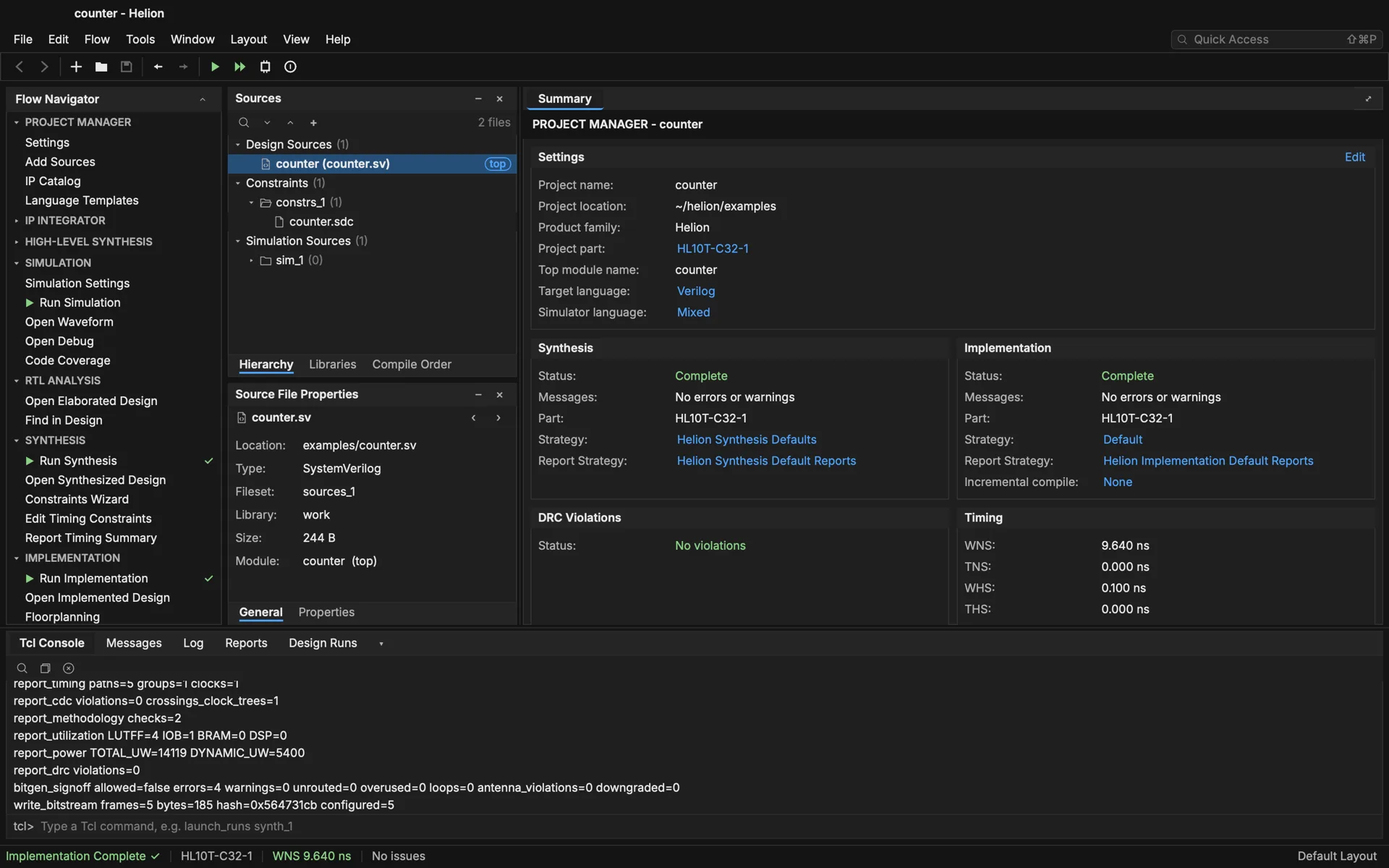
Flow navigator, device view, schematic view, timing reports, a waveform viewer, and a real Tcl console, all in one app.
Benchmarks.
Synthesis, PicoRV32 processor
8.9× faster
Helion1.02 sYosys9.12 sFull flow, PicoRV32 processor
3.0× faster
Helion3.5 sYosys + nextpnr10.4 sFull flow, AES-128
175× faster
Helion1.9 sYosys + nextpnr332 s
These are my own published runs. Synthesis compares Helion 3.0.0 with Yosys 0.33; the full-flow runs compare Helion 2.0.5 with Yosys 0.69 plus nextpnr-ecp5. In the full-flow runs Yosys used 2 to 5 times fewer LUTs and the two flows target different chips, so read this as a speed comparison, not a quality one.
Technical details.
- Input
- SystemVerilog, VHDL-2008 subset, C
- Flow
- synthesis, pack, place, route, timing, bitstream
- Chips
- HL10, Lattice iCE40, Lattice ECP5, Xilinx 7-series
- Checking
- SAT equivalence, CDC analysis, event simulator, SVA subset
- Debug
- FTDI JTAG engine, ILA, VIO, JTAG-to-AXI
- Timing gold
- WNS_PS=9640 on the counter example, checked in CI
- Interface
- CLI, Tcl, IDE
- Release
- 4.0.0, November 2026, AGPL-3.0
- Size
- 360,000+ lines of Rust in 30 crates, 1,900+ tests, 1,200+ commits
What I used
- Rust
- SystemVerilog
- VHDL
- PathFinder
- STA
- Tcl
Screenshots.
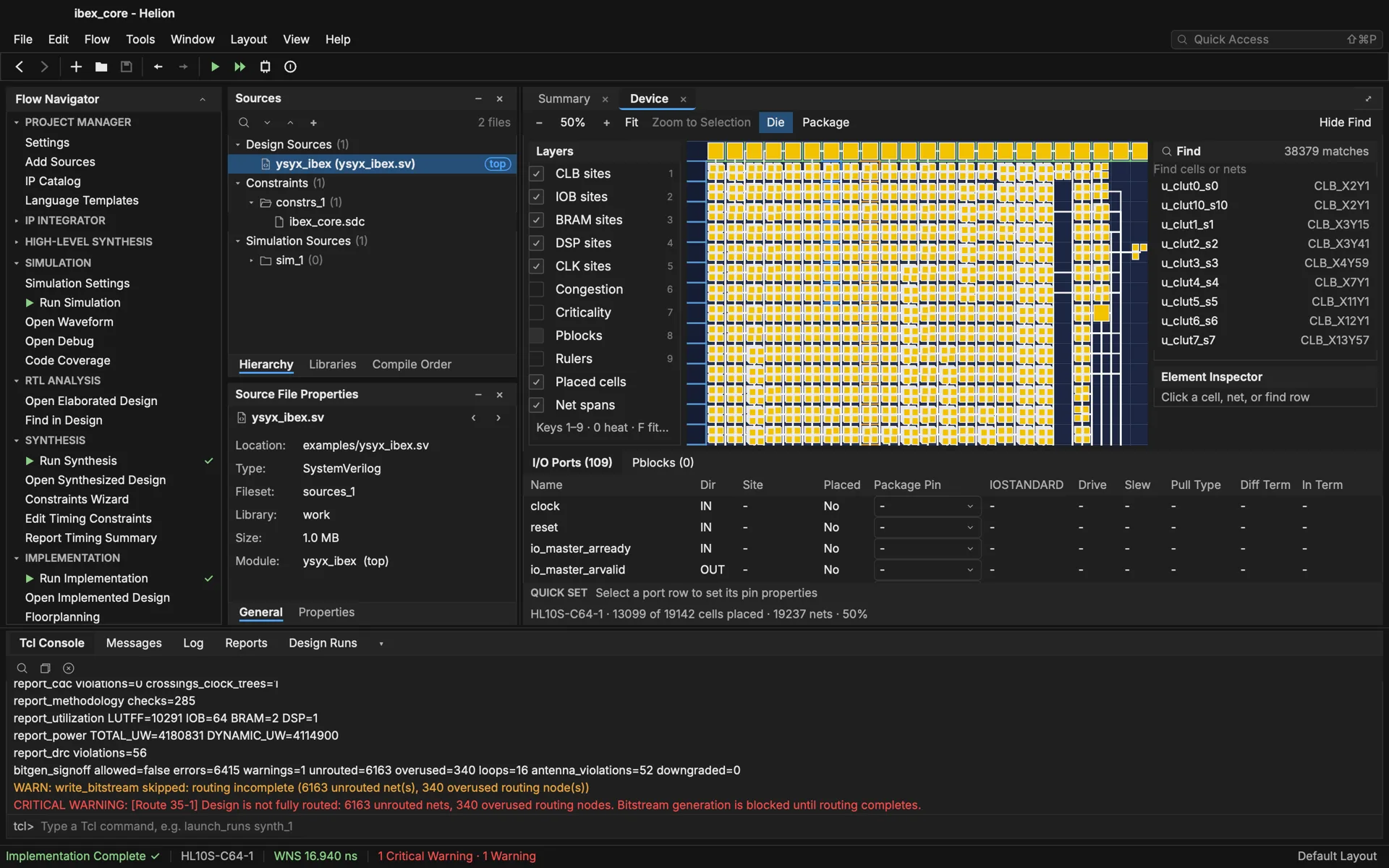
Device view: a RISC-V core placed on the HL10 chip 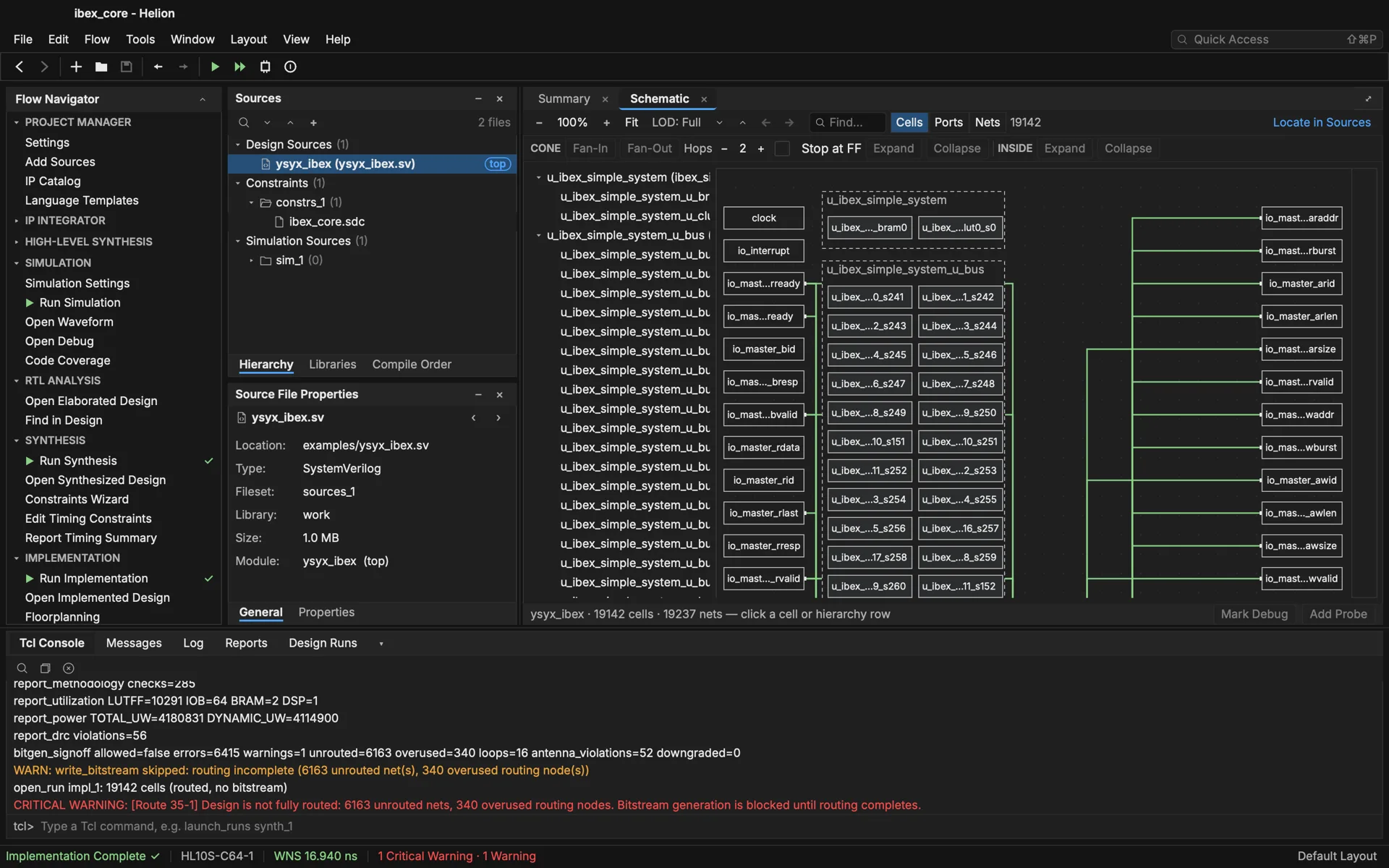
Schematic view of the same design 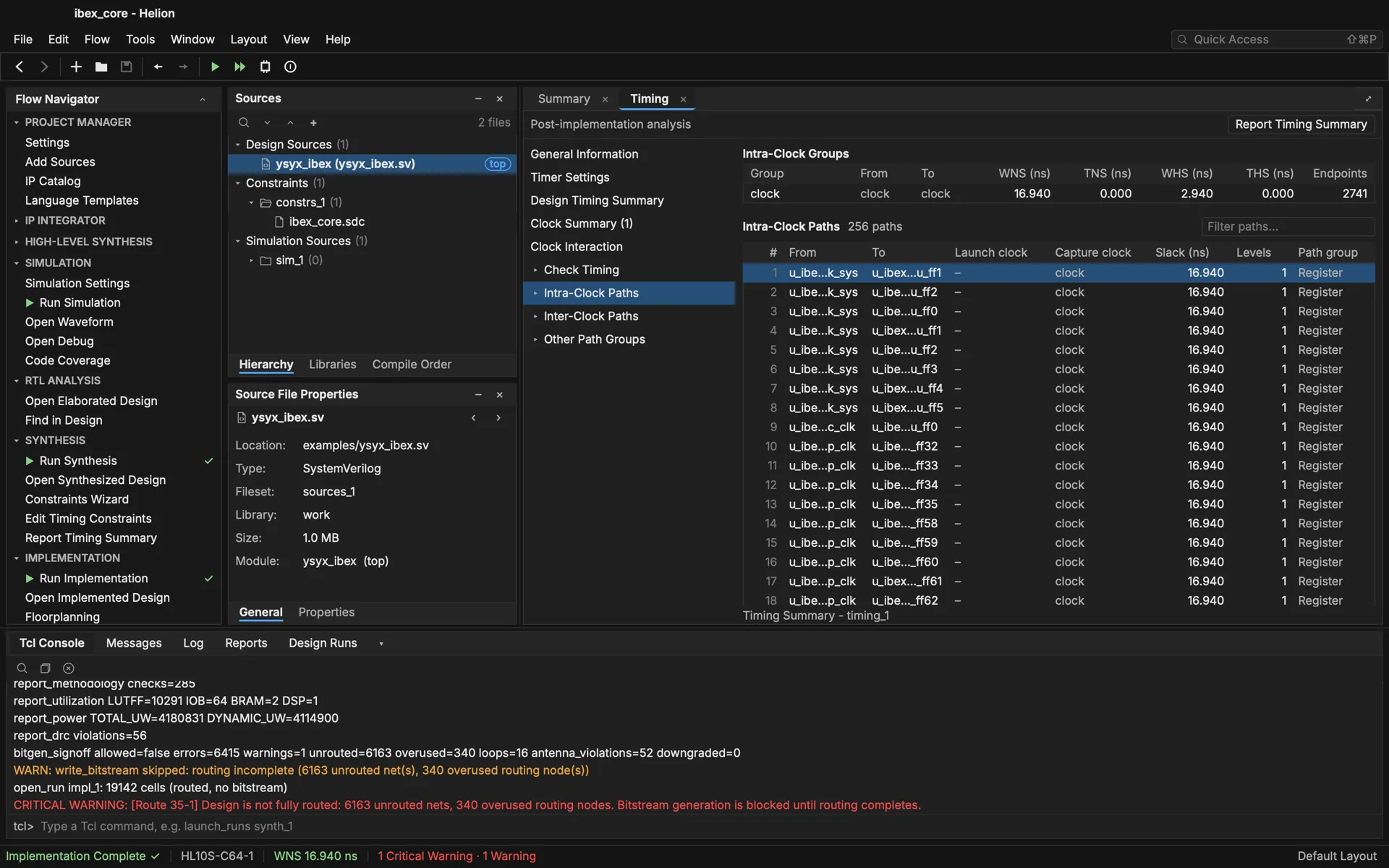
Timing report